

Farmer in focus: Hill Lock Orchard
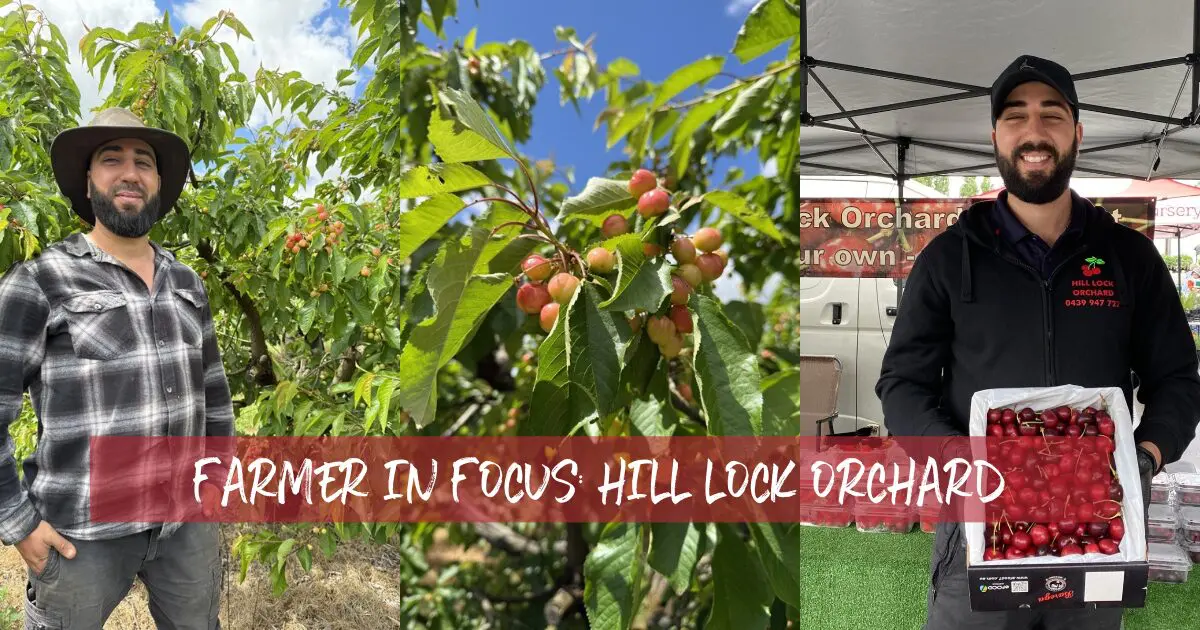
Hill Lock Orchard has been part of the Market since 2004, just months after we opened our gates. Every year the family’s cherries and strawberries arrive in November, followed by a changing run of fruit and vegetables right through until the following winter.
We recently caught up with Mohammed (Mo) in the orchard at Wombat, NSW, to hear how his dad built the farm from scratch, how they time their cherries to ripen one variety after another, what it’s like growing up in an orchard, and why he prefers a tart cherry to a sweet one.
Tell us a bit about yourself and where you’re located
My name is Mohammed and I’m from Hill Lock Orchard. We’re standing in my father’s orchard. It’s mainly a cherry orchard, but we also grow a range of other fruit and veg including strawberries, figs, plums and persimmons.
Who started the orchard, and how did your family come here?
My father started this property. We moved to this farm in 1998. Before that we ran another property in town from 1990 until 1998, but that was only ten acres. Now we’re sitting on close to two hundred acres. Dad has essentially built it all up from scratch, including all the varieties in the orchard. He’s built it pretty much since he’s been here.
Was he a farmer back home?
Funnily enough, Dad was originally a carpenter in Lebanon. But his father ran a similar style of orchard, so it was always a background hobby for him, and a passion. When he moved to Australia, orcharding was probably the first thing he could get into where he didn’t have to figure out the language as quickly. He started in it and just loved it from there. We’ve been here ever since.
Do you still use farming practices from Lebanon?
We definitely do. All the experience we had back then, we brought to Australia. The fruit we grow, and the whole idea of it, stemmed from our orchard in Lebanon. Luckily the technology is a lot more advanced now than it was back then, but that’s where it all began.
How many varieties of cherry do you grow?
In total we’ve got close to eighteen different varieties. Usually three varieties ripen each week, and the season runs for around six weeks, so every week you get three new varieties, one after another.
How do you get them to ripen one after the other?
Plenty of study. Every variety has a ripening window, and you have to time the orchard so that when one finishes, the next is ready. There are a lot of good varieties out there, but many ripen at the same time, so you pick and choose. I don’t want all my cherries ripe in a fortnight, you want to drag it out over six to eight weeks if you can. It comes down to chill hours and the different varieties. It’s a lot easier to figure out now with data available, but when Dad first started there was a lot of trial and error.
Cherries are a risky crop. What’s the biggest risk you face?
The weather isn’t what it used to be. When we started, winter was winter, summer was summer and spring was spring. Now we seem to get a lot of rain during harvest, which we don’t want, and when it doesn’t rain, we get a really bad drought. Right now, rain is our biggest risk, along with out of the blue hailstorms. Cherries are so sensitive to rain cracking. The fruit can look beautiful on the tree, but until it’s in the cool room, it means nothing.
Who works on the farm today?
Dad is still on the farm. He’s semi-retired, but he still does just as much work, he just doesn’t have the responsibility of it anymore, and that’s what he’s enjoying. My brother and I work on the property full time, and my younger brother works with us at the Market on weekends when he has time off from his normal job.
What was it like growing up on a working farm?
Not as exciting as you’d think. When you’re a little kid it feels like all you’re doing is working. But as you get older and go out into the real world, you realise how much serenity there is in farming. I was actually a civil engineer by trade, and now I’ve gone back to farming full time. Being out in the open with the trees brings a peacefulness you can’t get sitting behind a computer desk. And it’s a family business, so we’re all here together, which is great.
And now you have kids running around the orchard with you?
I’ve got a two-year-old who’s with Dad at the moment. I’ll be driving past on the buggy and he’ll hear me and stand at the front door waiting for me to pick him up. And I’ve got a nine-year-old and a six-year-old who are out there with me all the time on weekends. They love it.
You’ve been with the Market since 2004, 22 years. What does it mean to you?
The Market means everything to us. It switched our whole business from wholesale to dealing directly with customers, and gave us a whole new view of how our business runs. We really enjoy dealing directly with customers every week, rather than being someone sitting in an orchard sending fruit off to the wholesalers. We get to talk to the same customers every week. I’ve seen some of them almost more than I’ve seen some of my own family. They’re there every Saturday, and they support you. It’s almost like an extended family, stallholders and customers alike. It’s just a really good vibe.
It must be good to get that direct feedback.
The feedback we get is excellent. If we grow a few varieties of strawberries, say, customers tell us which one is the best and which flavour they like. Sometimes they give us ideas, like how come you don’t grow this particular fruit or vegetable, and I’ll say I don’t know, never tried it. Then sometimes we give it a go and it works out. Seeing what customers ask for at particular times of year helps us figure out how to run the business. At the end of the day, customers are the majority of the business, and it’s great to deal with them directly.
Describe the perfect cherry.
Funnilyy enough, a more tart cherry than a sweet one. I prefer something with more flavour than sweetness, because that way you can indulge in more cherries instead of getting a sugar high off the first bunch. And a nice mahogany colour. Our most popular variety is the Lapins: a nice 30 to 32 millimetre cherry with outstanding flavour. It’s very firm and crisp, large, with that perfect mix of tartness and sweetness.
A family business, three generations deep
From a carpenter’s hobby in Lebanon to close to two hundred acres at Wombat, Hill Lock Orchard has grown into one of the Market’s longest-standing stallholders, with Mo’s own kids now growing up between the trees just as he did. Twenty-two years of Saturdays later, it’s still the same thing that keeps the family coming back: the chance to hand a box of cherries straight to the person who’s going to eat them.